|
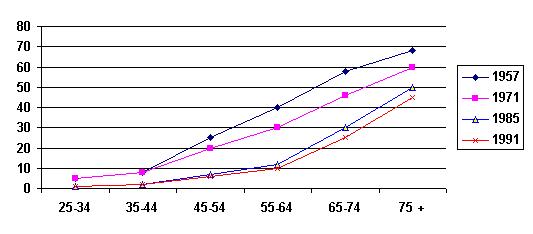
Figure 1. Edentulousness in U.S. adults, 1957, 1971, 1985 and 1991 5-7
Age Group (in years) |
By Kenneth Shay, DDS, MS
At the beginning of the twentieth century, about three million Americans (approximately 3% of the population) were 65 years of age or older. Fewer than 100,000 were 85 or older. Today there are over 33 million people over the age of 65 in the U.S., of whom over three and a half million are over the age of 85. There are now more people in this country over the age of 65 than there are children under the age of 14, and the proportion of those over the age of 85 is growing at a faster rate than that of any other age group.1 This dramatic shift in the age-mix of the population is discernable in every aspect of the modern human experience, from the age of characters in advertisements, books, movies, and TV shows to the way tax dollars and healthcare resources are allocated as well as the foci of biomedical and health sciences research.
The elderly are seeking dental care at an unprecedented rate and in numbers that outweigh their burgeoning proportion of the population. In 1991, Meskin et al. collected data from 1200 private dental practices in Minnesota, Arizona, Florida, Colorado, and Connecticut.2 The proportion of elderly patients seen in these practices exceeded their representation in the general population (see Table 1). This is in stark contrast to data from only 15 years earlier, from which Gift and Mankowski reported lower dental utilization in the elderly than in any other non-child age group.3
|
TABLE 1. Age distribution of dental patients reporting for care in several states, and the practice income attributable to those visits |
|||
| % Elders in State Population | % of Dental Visits by People Over Age 65 | % of Practice Income Due to Patients Over 65 | |
| Minnesota | 12.4 | 14.33 | 13.60 |
| Colorado | 8.8 | 11.43 | 12.49 |
| Connecticut | 12.9 | 13.88 | 11.76 |
| Florida | 17.6 | 25.60 | 27.97 |
| Arizona | 12.3 | 18.51 | 20.67 |
A striking proportion of the older patients in today's dental practices requires
maintenance and preventive therapy, as described by Gambucci et al. (see Table
2).4 Due to this growing number of elders utilizing professional oral prevention services,
dental hygienists need to have accurate knowledge about this emerging group of
patients. Many misconceptions and false stereotypes, both positive and negative, about
older people may be held by health providers of any age, and these may inadvertently
and incorrectly influence assessment, diagnosis, and management approaches. This
brief article will discuss certain incorrect beliefs or "myths" about America's elderly
that need to be set right in order to achieve a balanced and appropriate clinical approach
to these patients.
|
TABLE 2. Services rendered patients of different age groups in general dental practices in the state of Minnesota, 1985. |
||||
| "Continuing Care" | Maintenance | Crown and Bridge | Removable Prostho | |
| 1 - 19 | 34.8 | 52.5 | 1.1 | 0.2 |
| 20 - 39 | 41.7 | 43.9 | 10.0 | 1.6 |
| 40 - 59 | 46.1 | 37.1 | 17.5 | 7.5 |
| > 60 | 46.1 | 31.9 | 13.0 | 20.7 |
Myth 1: "Most Old People Have Lost Their Teeth"
|
Figure 1. Edentulousness in U.S. adults, 1957, 1971, 1985 and 1991 5-7
Age Group (in years) |
As recently as 1971, about 50% of Americans
over age 65 were edentulous (Figure
1).5 But as people who were children in the 1920s and 1930s have
become "the elderly," a striking number of them
have retained some or much of their natural dentitions.
The latest nationwide data, collected 1988-1991,
showed that about 27% of Americans age 65-74 were
edentulous; this means that nearly three-fourths of this
group are candidates for the services of dental
hygienists. The dentate members of this age group have an
average of 19 teeth; over age 75, this figure is over
16, which represents nearly 60% of the intact adult
dentition.6,7 Providers who inaccurately assume
that toothlessness is inevitable with advancing age, or
who believe that edentulousness will be acceptable to
their older patients, may undersell the advantages of
preventive and restorative services, thereby
depriving older clients of needed treatment. Obviously this is unacceptable.
Myth 2: "Older People With Teeth Generally Have Severe Periodontal
Disease"
Current understanding of periodontitis is that most adults are affected by episodic, localized bouts of osteoclastic destruction ultimately resulting in measurable loss of attachment. Because older people have been exposed to these episodes of bone loss for more years than their younger counterparts, there is unquestionably more loss of attachment on average in older patients than younger ones.8 However, the 1991 National Health and Nutrition Examination Survey found relatively limited pocket depth and bleeding on probing — the currently accepted clinical signs of active periodontal disease — in the elderly, although subgingival calculus, recession, and loss of attachment were more pronounced in this group than at earlier ages (see Table 3).9
| Table 3. Selected measures of periodontal status, U.S. adults in the NHANES - III study, 1988 - 1991 10 | ||||||||||
| Sites With Pocket Depth > 4 mm | Sites With Bleeding on Probing | Sites With Subjingivat Calculus | Sites With Recession > 1 mm | Sites With Loss of Attachment > 3 mm | ||||||
| Age | % Pts. Affected | % Sites Per Pt. | % Pts. Affected | % Sites Per Pt. | % Pts. Affected | % Sites Per Pt. | % Pts. Affected | % Sites Per Pt. | % Pts. Affected | % Sites Per Pt. |
| 25-34 | 33.1 | 3.0 | 62.5 | 10.4 | 67.4 | 21.7 | 29.0 | 3.4 | 28.0 | 4.0 |
| 35-44 | 34.2 | 3.9 | 60.1 | 11.1 | 69.2 | 24.2 | 46.3 | 8.3 | 43.6 | 9.1 |
| 45-54 | 40.0 | 5.0 | 59.9 | 11.7 | 70.0 | 25.7 | 66.3 | 18.4 | 63.0 | 17.8 |
| 55-64 | 45.1 | 5.6 | 59.6 | 12.3 | 74.4 | 29.6 | 78.3 | 27.9 | 74.1 | 26.2 |
| >65 | 37.6 | 4.1 | 61.9 | 14.5 | 75.1 | 30.6 | 86.5 | 35.5 | 81.5 | 30.8 |
There are several important implications of these findings for dental hygienists.
First, the presence of calculus and the absence of severe pocket depth indicate that the
major periodontal treatment needs in most of these patients will be non-surgical (scaling
and localized root planing). Second, the likelihood for significant loss of
attachment suggests that interproximal oral hygiene measures other than floss — such as
interproximal brushes — should receive serious consideration even for patients who
have not undergone periodontal surgery since furca and interproximal root concavities
may lurk within the gingival sulcus. Finally, the widespread recession in the elderly
makes the likelihood for root caries attack to be greater in this group than in any other.
For this reason, measures focused on prevention of root caries (such as an
ADA-accepted sodium fluoride dentifrice, supplemental fluoride rinses and/or gels, also
dietary counseling) should become part of the plan of care for many
seniors.10
Myth 3: "A Dry Mouth is a Normal Part of Growing Old"
This myth is absolutely incorrect; studies on well-controlled populations of all ages, with measures repeated over time, reveal minimal salivary flow and composition changes in healthy adults as they grow older.11,12 Nevertheless, dry mouth is highly prevalent in advanced age usually because of disease frequently affecting older people or, more likely, medications taken to control those diseases.13 The seriousness of a dry mouth cannot be overemphasized, because saliva is a key and indispensable protector of the oral cavity.14 When salivary flow is modified, the acidity of the mouth rises; remineralization of incipient caries is impeded; oral microbial counts climb; and taste, swallowing, speaking, chewing, and use of oral prostheses are impaired.
The fact that a dry mouth is not a normal part of aging means that steps should be taken to identify the cause of the hypofunction and diligence applied to protect the dentition. The dentist must be made aware of the condition and urged to work with the patient's physician to modify the pharmacological regimen or otherwise get to the source of the problem. Patients whose salivary status cannot be returned to normal should be educated about the possible consequences of the dryness and put on a more frequent recall. An aggressive program of high-potency home fluoride gel is required, and salivary substitutes may be recommended as well.
Myth 4: "Most Old People Are Sick and Poor and Live in Nursing Homes"
An important lesson to learn about older Americans is that they are a uniquely diverse group. Their age group spans over forty years - more than two generations - and they have lived through a century (or more) that has arguably seen more change than any other in human memory.15 An important key to building a positive working relationship with older clients is to recognize - as one should for patients of any age - the individuality of each.
It is true that over 50% of people over the age of 65 carry a diagnosis of at least one chronic disease, usually arthritis or hypertension, but possibly cardiovascular disease, diabetes, or others.16 Yet due to improved health styles and medical therapies, most enjoy a greater level of activity and abilities than similarly diagnosed people of earlier generations could achieve. Even among people who report total inability in at least one necessary daily activity or who report their own health as only fair, annual dental services are obtained at 60% of the rate expected for healthy, fully abled people.17 Most older patients can be expected to continue to seek dental services as they age, although their home care may become more challenging through medication-reduced salivary flow or problems with visual acuity or manual dexterity.
It is true that several million elders live near to or below the poverty level, and there are populations of elders (notably, single females and minorities of either sex) who suffer from poverty to a greater extent than most. The impoverished state is more concerning for older people because most have finite resources despite growing health costs. But over 70% of the discretionary spending in America is done by those over age 50.18 Countless elders buy new homes and cars, take elaborate vacations, and indulge their desires to continue to enjoy life. Dental providers should avoid drawing conclusions about the importance that an older client will place on costs related to dental care; only the patient can determine that.
Only about one and a half million elders (5% of all people over the age of 65) reside in nursing homes. The number is about 1% of those aged 65-74, 7% of 75-84, and about 20% of those age 85 and older.19 In addition, about two to three times those numbers have disabilities equal to those in nursing homes, 20 but are able to reside in their communities through the help of relatives, friends, and public and private services. However, as described above, a lifetime habit of regular dental care does not disappear with advancing age. Community-dwelling seniors continue to obtain dental services despite frailty. Admittedly, those residing in nursing homes are a different matter because of their geographic isolation, high rates of impoverishment, and severe frailty and/or cognitive impairment. Yet dental professionals throughout the country are increasingly diligent in instituting local efforts to reach the elderly in long-term care institutions as well.
Summary
The current trend of increased tooth retention in the elderly is expected to increase, and the number of seniors is expected to keep growing as the "Baby Boomers" begin to cross the threshold out of middle age. Dentistry for older adults will increasingly become focused on prevention and maintenance, rather than on restoration and replacement. Dental hygienists will unquestionably continue to play increasingly important roles in the maintenance of oral health for the older patients in their practices. As such, hygienists need to seek out and undertake educational opportunities to enhance their abilities to provide appropriate care to this diverse and important group of patients.
Kenneth Shay, DDS, MS
Kenneth Shay is chief of dental service at the Ann Arbor VA Medical Center and adjunct associate professor of Hospital Dentistry, University of Michigan School of Dentistry, Ann Arbor, Michigan.
References
1. Campion EW: The oldest old. N Engl J Med 330(25):1819-20, 1994.
2. Meskin LH, Dillenberg J, Heft MW, et al.: Economic impact of dental service utilization by older adults. J Amer Dent Assoc 120:665, 1990.
3. Gift HC, Mankowski L: Utilization of dental services: 1978 National Public Survey. J Dent Res 58 (Spec Iss):132, abstract 159, 1979.
4. Gambucci JR, Martens LV, Meskin LH, et al.: Dental care utilization patterns of older adults. Gerodontics 2:11, 1986.
5. National Center for Health Statistics: Edentulous persons, United States, 1971. Data from the National Health Survey. Vital and Health Statistics. Series 10, No. 89. DHHS Pub. No. (HRSA), pp. 74-1516, 1974.
6. Miller AJ, Brunelle JA, Carlos, JP et al.: Oral Health of United States Adults. U.S. Department of Health and Human Services. NIH Pub. No. 87-2868. National Institutes of Health, Public Health Service, Washington, DC, U.S. Government Printing Office, 1987.
7. Marcus SE, Drury RF, Brown LJ, et al.: Tooth retention and tooth loss in the permanent dentition of adults: United States, 1988-1991. J Dent Res 75(Spec Iss):684-95, 1996.
8. Burt BA: Periodontitis and aging: reviewing recent evidence. J Amer Dent Assoc 125:273-9, 1994.
9. Brown LJ, Brunelle JA, Kingman A: Periodontal status in the United States, 1988-1991: preva- lence, extent, and demographic variation. J Dent Res 75(Spec Iss):672-83, 1996.
10. Shay K: Identifying and addressing the challenges of oral care for the elderly patient. Current Opinion in Periodontology 205-211, 1994.
11. Heft MW, Baum BJ: Unstimulated and stimulated parotid salivary flow rate in individuals of different ages. J Dent Res 63(10):1182-5, 1984.
12. Wu AJ, Atkinson JC, Fox PC, et al.: Cross-sectional and longitudinal analyses of stimulated parotid salivary constituents in healthy, different-aged subjects. J Gerontol Med Sci 48(5):M219- 24, 1993.
13. Atkinson JC, Fox PC: Salivary gland dysfunction. Clin Geriatric Med 8(6):499-511, 1992.
14. Mandel ID: The role of saliva in maintaining oral homeostasis. J Amer Dent Assoc 119(2):298- 304, 1989.
15. Ettinger RL: Cohort differences among aging populations: a challenge for the dental profession. Spec Care Dentist 13(1):19-26, 1993.
16. National Center for Health Statistics: Prevalence of selected chronic conditions: United States, 1986-88. Vital and Health Statistics, series 10, no. 182. DHHS pub. no. (PHS) 93-1510, 1993.
17. Gift HC Newman JF: How older adults use oral health care services: results of a National Health Interview Survey. J Am Dent Assoc 124(1):89-93, 1993.
18. Meskin LH, Mason LD: Problems in oral health care financing for the elderly. Clin Geriatr Med 8(3):685, 1992.
19. Evashwick CJ and Langdon B: Nursing Homes. In The Continuum of Long-term Care: An Integrated Systems Approach, ed. Evanshwick CJ, USA, Delmar Publishers, pp. 43-59, 1996.
20. Kane RL, Ouslander JG, Abrass IB: Essentials of Clinical Geriatrics, 2nd Ed. New York, McGraw-Hill. 1984.
Reprinted with permission.
Dental Hygienist News. Vol. 9, No.3.